VEU Rebate Guide: How Victorian Energy Upgrades Discounts Actually Work
August 12, 2026
If you’ve been quoted for a new split system or heat pump in Melbourne lately, you’ve probably seen a line on the quote called a VEU rebate. It’s real, it’s a Victorian Government program, and for a lot of homes it takes thousands off the upfront price.
It’s also widely misunderstood. It isn’t cash back. It isn’t automatic. And it isn’t something you can chase up after the installer has packed up and driven away.
Here’s how the VEU rebate actually works, what you can expect to get, and what to check before you sign anything.
Quick answer: VEU stands for Victorian Energy Upgrades. It’s a Victorian Government program that discounts approved energy-efficient upgrades. An accredited provider applies the discount to your quote before you pay, so you only ever pay the balance. Your eligibility depends on what you’re replacing, what you’re installing and who installs it.
What is VEU?
Victorian Energy Upgrades is a state government program that lowers the cost of approved energy-efficient products and installations. It’s open to Victorian households and businesses, and it’s run under rules set by the Essential Services Commission.
Every eligible upgrade creates certificates called VEECs — Victorian Energy Efficiency Certificates. One certificate represents one tonne of greenhouse gas emissions avoided. Accredited providers create those certificates once approved work is done, and the certificates are traded to large energy retailers who are required to buy them. That certificate value is what funds your discount.
You don’t have to understand any of that to benefit from it. You just need to know one thing: the discount comes off your quote at the start, not back into your bank account at the end.
The VEU rebate is not income tested. There’s no means test, no application form for you to fill in, and no waiting on a government payment.
How much is the VEU rebate worth?
There’s no single energy rebate Victoria households receive for every job. The amount depends on what you’re pulling out, what you’re putting in, and how big it is. Replacing an old ducted gas heater with a modern reverse-cycle system creates far more certificates than swapping one air conditioner for a slightly better one.
These are the indicative household discounts published by the Victorian Government for heating and cooling.
Installing a room (split) reverse-cycle air conditioner
What you’re replacing
New system size
Indicative discount
Hard-wired electric resistance room heater
3kW–9kW
Up to $840
Ducted (whole-of-home) gas heater → 4 split systems
1 × 8kW + 3 × 3kW
Up to $2,520
Ducted (whole-of-home) gas heater → multi-split
1 × 10kW outdoor unit
Up to $2,940
Non-ducted (single room) gas heater
3kW–9kW
$630 – $1,610
Existing non-ducted reverse-cycle air conditioner
3kW–9kW
$210
Nothing removed (new installation)
3kW–9kW
$70 – $140
Installing a ducted reverse-cycle air conditioner
What you’re replacing
New system size
Indicative discount
Central electric resistance ducted heater
10kW–22.4kW
Up to $5,460
Ducted gas heater
10kW / 16kW / 22.4kW
Up to $2,520 / $4,200 / $5,530
Existing ducted reverse-cycle air conditioner
10kW / 16kW / 22.4kW
Up to $490 / $770 / $910
Nothing removed (new installation)
10kW–22.4kW
Up to $410
Two things worth pulling out of those tables.
The biggest discounts come from getting off gas. If you’ve got ducted gas heating, you’re sitting on the largest VEU rebate available to a Victorian home.
You can still qualify with nothing to remove. It’s a small discount, but a brand-new installation isn’t automatically excluded. Plenty of quotes tell people otherwise.
For heat-pump hot water, the VEU discount is more modest — indicatively up to around $630 when you’re replacing an electric resistance system, and up to around $560 replacing gas. The bigger money on hot water usually comes from stacking VEU with the Solar Victoria rebate, which we cover further down.
Figures are indicative, set by the program, and change as certificate values move. Your quote shows your exact rebate amount.
Who can get the VEU rebate?
All Victorian households and businesses can access VEU discounts, including private rental properties. What decides your actual eligibility is the detail of your property and your existing appliance.
An accredited provider will look at:
your property type and postcode
your current appliance, its age and its fuel source
the exact make and model going in
what the installation involves
how the old system will be decommissioned and removed
A few rules catch people out:
The system you’re replacing generally needs to be more than two years old.
Homes built in the last two years usually can’t claim upgrades that involve decommissioning an appliance.
For a home reverse-cycle system, the product must carry a minimum five-year warranty.
Efficient isn’t the same as approved. A product only qualifies if that exact model is listed on the VEU Register of Products for that activity. Ignore any ad that claims a whole range qualifies.
Can renters get a VEU discount?
Yes, for a lot of upgrades. But heating, cooling and hot water are fixed to the property, so your rental provider needs to approve the work. The government’s own advice is that renters and rental providers plan these upgrades together.
Before anything starts, get agreement in writing on:
who approves the upgrade
who pays the balance after the discount
who owns the new system
who handles repairs later on
whether owners corporation approval is needed
What’s changing in 2027 (and why it matters now)
Victoria is phasing in new electrification and minimum efficiency standards from 1 January 2027. If you own a home or rent one out, these are worth knowing about before your current system dies on you.
If you own and live in your home: from 1 March 2027, when a gas hot water system fails and can’t be repaired, it has to be replaced with an electric alternative such as a heat pump. There’s no requirement to replace gas heating or cooktops.
If you rent out a property: from 1 March 2027, when a hot water or heating appliance fails beyond repair, it must be replaced with a heat pump water heater or an efficient reverse-cycle air conditioner in the main living area. At the start of a new lease, rental homes will also need efficient cooling in the living area and 4-star showerheads, with insulation requirements phasing in as well.
New homes must be all-electric from January 2027.
The practical takeaway: if your gas system is on its last legs, you’ll likely be replacing it with electric anyway. Doing it on your own timeline, with a full VEU discount and a proper assessment, beats doing it in a panic on the coldest week of the year.
Heating and cooling upgrades
Old heating is where most Melbourne homes are quietly losing money. Ducted gas heaters, wall furnaces and hard-wired electric heaters all cost more to run than a modern reverse-cycle system, and none of them cool the house in February.
Upgrades that can qualify include replacing:
ducted gas heating
gas space and wall heaters
hard-wired electric heaters
older air conditioners
People often search for a Victorian Government split system rebate. That’s this — a VEU discount applied to an approved split system, shown on your installer’s quote before you pay. There’s no separate scheme, and no cheque in the mail afterwards.
Sizing matters more than most quotes admit
A unit that’s too small will run flat out and never quite get there. One that’s too big will short-cycle, which is noisy, less efficient and harder on the equipment. Neither problem shows up on a quote — it shows up in July.
A proper assessment covers your current system, the rooms you actually want conditioned, the size and layout of the home, where the units can go, switchboard capacity, drainage and pipework, and how the old system gets removed.
Smart Upgrades pricing
Our current heating and cooling packages, with the VEU discount already applied:
Ducted reverse-cycle from $4,800 supply and install — 8 vents, 3-zone system, WiFi smart control. 23kW and 25kW options available.
4 split systems from $2,299 supply and install (8kW + 5.6kW + 3.6kW + 3.6kW)
5 split systems from $2,999 supply and install (7.1kW + 3.6kW + 2.8kW + 2.8kW + 2.8kW)
Single split systems from $599 per indoor unit after the VEU rebate is applied
Ducted and multi-split offers require existing ducted gas heating to qualify. Extras are quoted separately, and we approve them with you before we do them.
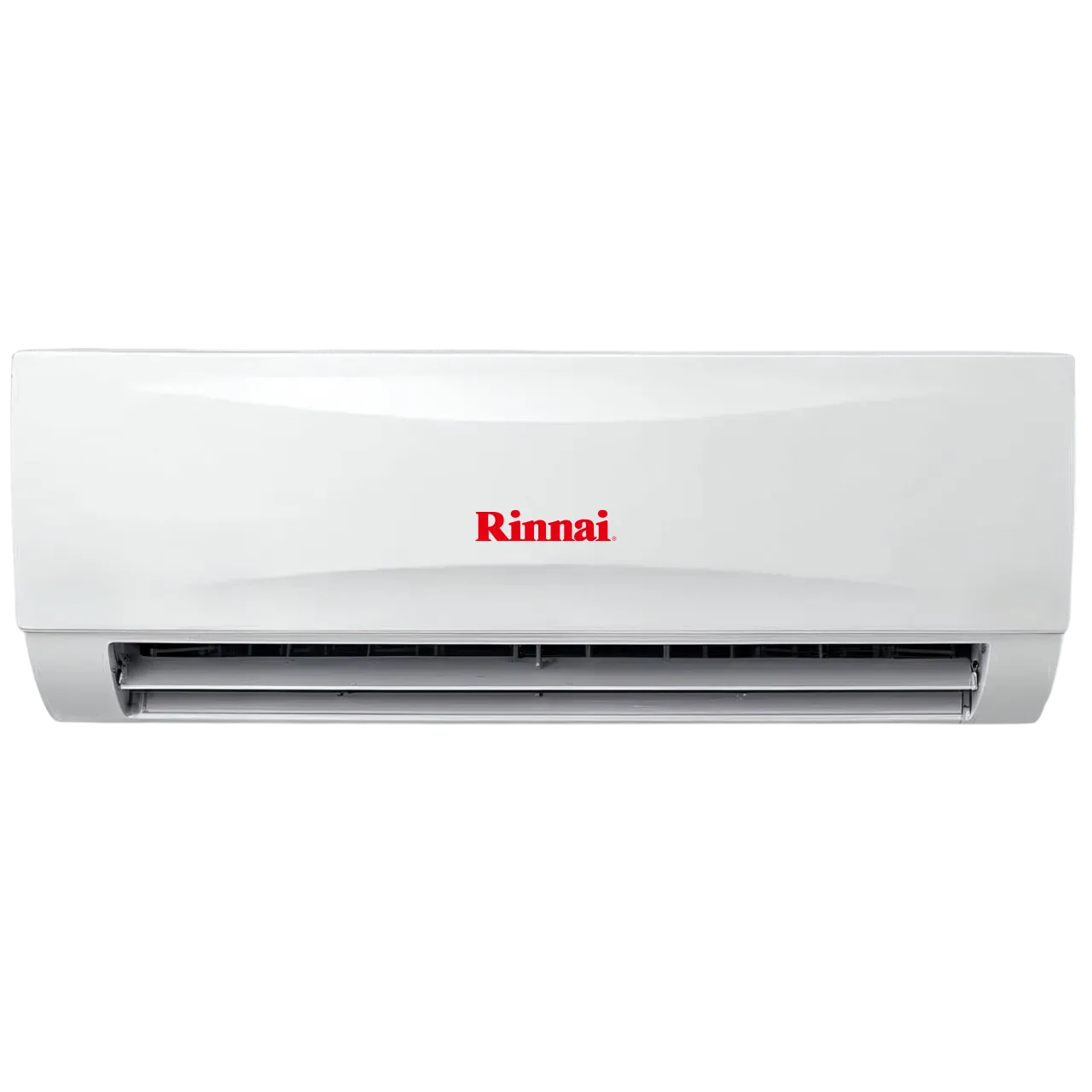
Approved brands: Midea, Mitsubishi Electric and Rinnai. All come with a 7-year product warranty, and we back every heating and cooling install with our own 5-year workmanship warranty.
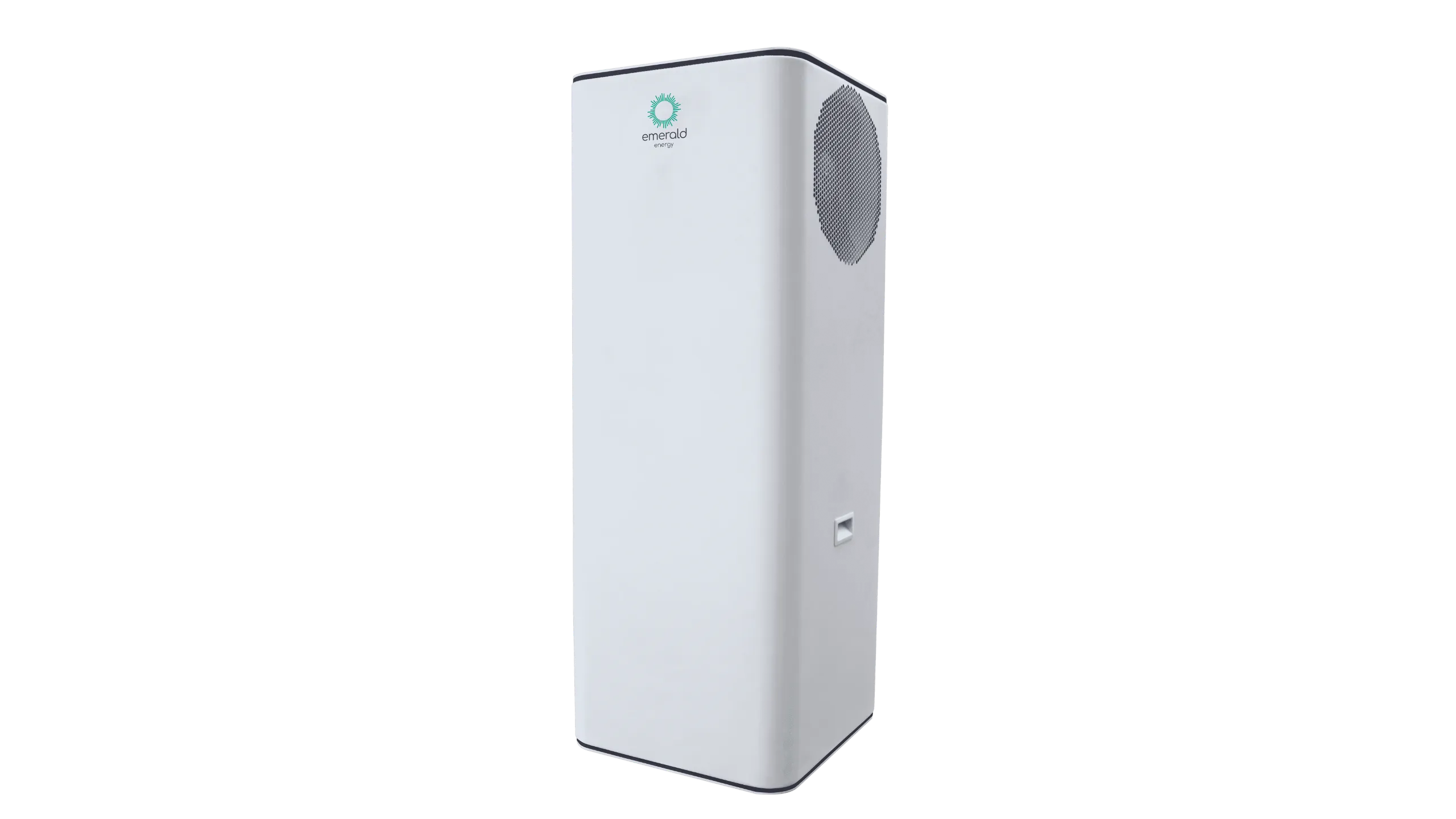
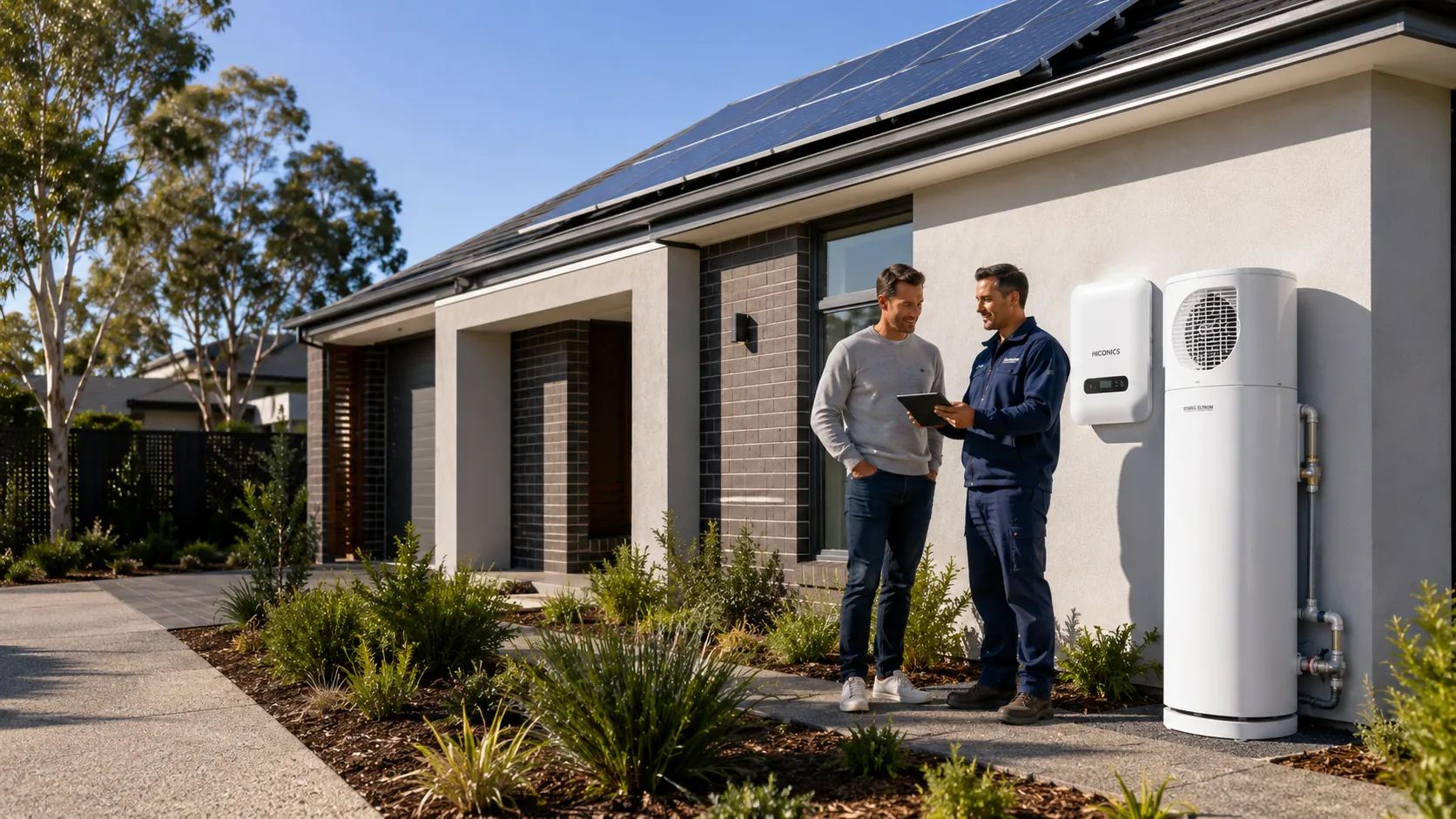
A heat pump doesn’t make heat the way an old electric element does. It moves heat out of the air and into your tank, which is why it uses a fraction of the energy for the same hot shower.
Whether you qualify depends on the system you’ve got now — the VEU hot water activities cover heat pumps and electric-boosted solar replacing either electric resistance or gas and LPG systems. The new unit has to be an approved model.
A good provider will check your current system and its fuel source, how much hot water your household actually uses, the right tank size, where the unit can sit, airflow around it, plumbing and electrical work, noise if it’s near a bedroom, and removal of the old tank.
Two photos speed this up enormously: one of the whole unit, and one clear shot of the model label. That’s usually enough for us to confirm what you’ve got.
Can you combine VEU with the Solar Victoria rebate?
For heat-pump hot water, often yes — and this is where the numbers get interesting. But they’re two separate programs with separate rules, and qualifying for one tells you nothing about the other.
The Solar Homes hot water rebate from Solar Victoria is worth up to $1,000, or up to $1,400 for eligible locally made products. It’s calculated as 50% of the product purchase price, applied after your VEU and STC discounts. Combined with the VEU discount, that’s up to around $2,030 off an eligible locally made system, or up to $1,630 for other eligible systems.
Solar Victoria’s rules are tighter than VEU’s:
you must be the owner-occupier — this one is not available to renters or investors
combined household taxable income must be under $150,000 (this dropped from $210,000 on 1 July 2026)
property value under $3 million
the hot water system being replaced must be at least 3 years old
one hot water or battery rebate per property address
you must use an authorised hot water retailer, which is a separate approval from VEU accreditation
rebates are released in limited batches, and you generally need pre-approval and a QR code before installation, with 120 days to install
There’s an exception for genuine emergencies — if your system fails, you don’t have to wait for approval before replacing it, but you do have to prove eligibility afterwards.
Don’t accept a quote or pay a non-refundable deposit until both programs have been checked properly.
Can you claim the VEU rebate after installation?
No. Not for heating, cooling or hot water.
The discount has to be arranged before work starts, because the accredited provider needs to verify the old appliance, the new product, the installer and the evidence required to create the certificates. Once the old unit is in a skip, that evidence is gone.
If you’ve already bought equipment or booked an installer, talk to an accredited provider before anything is switched off.
Your rights under VEU
The program has real consumer protections, and any provider worth dealing with will volunteer this information rather than wait to be asked.
Before work starts, you should be told what’s being installed, who’s installing it, the total price, the discount, any extra fees, what happens to your old appliance, your warranties, your cooling-off rights and how to complain if something goes wrong. You get 10 full business days to change your mind.
Cold calling and door knocking are banned under the VEU program. Since May 2024, VEU businesses can’t cold call you. Since August 2024, they can’t knock on your door either. If someone turns up unannounced offering a government rebate, that’s not a hard sell — it’s a breach.
Be careful if a salesperson:
pressures you to sign on the spot
tells you every home qualifies
promises a “free” system without inspecting yours
won’t give you a model number in writing
asks you to sign a blank or incomplete form
gets vague when you ask what could add to the price
How we do it instead
We only contact people who contact us first. No cold calls, no door knocking, ever. You get a fixed-price quote with every line itemised and the VEU rebate shown as a clear deduction, so you can see exactly what the program covers and exactly what you’re paying. If we find something during installation that adds cost, we stop and get your approval before we touch it.
Our installers are licensed, insured and based in Melbourne. We give you a 2-hour arrival window, we leave your home clean, we check in after 30 days, and if something needs attention we prioritise it within 2 business days. One local team, and we answer the phone.
How to arrange a VEU upgrade
1. Gather a few basics. You don’t need everything to make an enquiry. Your postcode, property type, whether you own or rent, your current appliance and roughly how old it is, and what you’d like to upgrade. Photos help but aren’t essential for a first check.
2. Get the exact product in writing. Brand and model, not “a 7kW split system”. Only listed models qualify, and the difference between two similar-looking units can be the whole rebate.
3. Check the provider is accredited. Only an accredited provider can create VEECs and apply the discount. They can install the system themselves or work with a partner installer — both are fine, as long as it’s clear who’s doing what. You can look up any provider on the public registry at veu.esc.vic.gov.au, and the Victorian Government publishes accredited provider lists by region on energy.vic.gov.au. You’ll find us there for Greater Melbourne under our accreditation name, Smartt Sales.
4. Compare the installed price, not the rebate. A bigger advertised discount on a more expensive system leaves you worse off. Line up the full cost: product, standard installation, the VEU discount, your final balance, likely extras, removal of the old appliance, and both the product and workmanship warranties.
5. Keep your paperwork. Quote, contract, invoices, payment records, warranties, compliance certificates, product documents and any written approvals from your rental provider or owners corporation.
Questions worth asking any provider before you accept a quote: Are you accredited? Do you offer this upgrade in my postcode? Is this exact model approved? Who’s installing it? What’s included, and what would add to the price? Who removes the old system? What warranties do I get, and who backs them?
Other VEU upgrades for homes
Heating, cooling and heat-pump hot water are what we do. The program covers more than that, and it’s worth knowing what else is on the list:
induction cooktops
ceiling insulation
window replacement and retrofit (glazing)
weather sealing and draught proofing
efficient fridges, freezers, TVs and clothes dryers
water-efficient showerheads
in-home energy display units
home energy rating assessments
Not every provider offers every activity, so check that whoever you’re talking to actually does the upgrade you want, in your area.
Frequently asked questions
Is the VEU rebate income tested?
No. Victorian Energy Upgrades has no income test and no means testing. Eligibility depends on your property, the appliance you’re replacing and the product being installed. The separate Solar Victoria hot water rebate is income tested — under $150,000 combined household income since 1 July 2026 — so don’t assume the two work the same way.
Can I get a VEU rebate if I’m not replacing anything?
Yes, but it’s small. A new reverse-cycle installation with no decommissioned appliance attracts an indicative $70–$140 for a room system, or up to $410 for ducted. The substantial discounts come from removing an old gas or electric resistance heater.
How old does my system have to be?
Generally more than two years old for the appliance being replaced. Homes built within the last two years usually can’t claim upgrades involving decommissioning. For the Solar Victoria hot water rebate, the system being replaced must be at least three years old.
Do I need my landlord’s approval?
For heating, cooling or hot water, yes — they’re fixed to the property. Private rentals are eligible for VEU discounts, but the rental provider needs to approve the work, and it’s worth agreeing in writing who pays the balance and who handles future repairs.
How long is the cooling-off period?
10 full business days under the VEU program.
What if my hot water system dies tomorrow?
Emergency replacements are handled differently. Solar Victoria lets you install first and prove eligibility afterwards, and VEU still needs to be arranged through an accredited provider before work starts. Call us on 1300 998 769 and we’ll sort out the order of operations with you.
Get a free VEU eligibility check
Start with what you already know. Give us your postcode, your property type and a rough idea of what you’ve currently got, and we’ll tell you which upgrades your home qualifies for and what they’d cost after the rebate.
No cold calls afterwards. No pressure. Just a straight answer and a fixed-price quote if you want one.
Rebate amounts vary based on system type, size, and what you are replacing. Rebates are subject to change. Terms and conditions apply. Your quote shows your exact rebate amount. Eligibility depends on your appliance, property, the product installed and current program rules.